Key Takeaways

  • Video game addiction lawsuits target major gaming companies like Epic Games, Roblox, and Microsoft for allegedly designing games with addictive features that harm players, particularly children and young adults.

  • Families can pursue legal action if their child developed gaming addiction, has documented medical diagnosis or treatment records, and shows academic decline or mental health problems linked to excessive gaming.

  • Over 100 lawsuits are now coordinated in California courts, with no settlements finalized yet but legal experts estimating potential compensation could exceed $250,000 for cases with severe documented harm.

Video Game Lawsuit Overview

Video game lawsuit claims are being filed by families across the country who allege that major gaming companies like Epic Games, Roblox, Microsoft, and others intentionally designed their products to be addictive – particularly for children and teens.

These gaming addiction lawsuits argue that developers used manipulative game mechanics, psychological tactics, and predatory monetization strategies to keep young players engaged for prolonged periods, leading to severe mental, emotional, and physical harm.

Video Game Addiction Lawsuit Featured Image; Video Game Lawsuit Featured Image; Current Status of Video Game Addiction Litigation; Allegations Against Video Game Companies; Types of Damages Caused by Video Game Addiction; Video Game Addiction_ Psychological Damages; Video Game Addiction_ Physical Damages; The Health Effects of Video Game Addiction on Young Users; Researching the Health Effects of Video Game Addiction; Eligibility for the Video Game Addiction Lawsuits; Video Game Addiction Lawsuit Legal Overview; Major Developers Facing Video Game Addiction Lawsuits; How Can a Video Game Addiction Cause Mental and Physical Harm; Psychological Tactics_ Addictive Game Mechanic Design; Incentivizing In-Game Purchases Through Microtransactions; Physical and Mental Health Effects of Internet Gaming Disorder; Recognizing the Signs of Video Game Addiction; Physical Injuries and Health Consequences; Long-Term Effects of Video Game Addictions; Emotional, Social, and Academic Impact of Gaming Addiction; Ethical and Legal Boundaries in Video Game Development; Do You Qualify for the Video Game Addiction Lawsuit; Gathering Evidence for Your Video Game Addiction Lawsuit; Potential Damages in Video Game Addiction Cases

Plaintiffs in these cases claim that video game developers prioritized profits over player safety by implementing features such as variable reward systems, loot boxes, time-limited events, and in-game purchases designed to exploit psychological vulnerabilities in developing brains.

Families affected by excessive gaming report that their children have experienced anxiety, depression, social isolation, sleep deprivation, and withdrawal symptoms including rage and emotional volatility.

TruLaw partners with video game addiction litigation leaders to provide clients with the legal resources and support necessary for a successful outcome.

If you or a loved one has suffered mental health issues, behavioral problems, or other harm due to video game addiction, you may be eligible to seek compensation.

Contact TruLaw using the chat on this page to receive an instant case evaluation and determine whether you qualify to join others in filing a video game addiction lawsuit today.

Video Game Addiction Lawsuit Featured Image; Video Game Lawsuit Featured Image; Current Status of Video Game Addiction Litigation; Allegations Against Video Game Companies; Types of Damages Caused by Video Game Addiction; Video Game Addiction_ Psychological Damages; Video Game Addiction_ Physical Damages; The Health Effects of Video Game Addiction on Young Users; Researching the Health Effects of Video Game Addiction; Eligibility for the Video Game Addiction Lawsuits; Video Game Addiction Lawsuit Legal Overview; Major Developers Facing Video Game Addiction Lawsuits; How Can a Video Game Addiction Cause Mental and Physical Harm; Psychological Tactics_ Addictive Game Mechanic Design; Incentivizing In-Game Purchases Through Microtransactions; Physical and Mental Health Effects of Internet Gaming Disorder; Recognizing the Signs of Video Game Addiction; Physical Injuries and Health Consequences; Long-Term Effects of Video Game Addictions; Emotional, Social, and Academic Impact of Gaming Addiction; Ethical and Legal Boundaries in Video Game Development; Do You Qualify for the Video Game Addiction Lawsuit; Gathering Evidence for Your Video Game Addiction Lawsuit; Potential Damages in Video Game Addiction Cases

Video Game Addiction Lawsuit Updates Timeline

December 10th, 2024: BC Supreme Court Approves Class Action Against EA Over Loot Boxes

The British Columbia Supreme Court has approved a class action lawsuit against Electronic Arts (EA) over its use of “loot boxes” in video games.

Loot boxes are in-game features offering randomized virtual items, such as currency, tools, or cosmetic upgrades, which can provide gameplay advantages.

Players can purchase these boxes with real money or virtual currency earned in-game.

The lawsuit accuses EA of designing loot boxes to obscure the low odds of obtaining valuable items, encouraging repeated purchases.

Popular EA games featuring loot boxes include FIFA, Madden NFL, NHL, NBA Live, and The Sims series.

Justice Margot Fleming allowed the case to proceed, noting that loot boxes rely on algorithms generating randomized rewards, often requiring real money for significant in-game progression or valuable item acquisition.

The plaintiff alleges that EA exploits players by structuring loot boxes to hide the true odds of receiving high-value rewards, fostering compulsive spending.

In response, EA denies the claims. Kerry Hopkins, EA’s senior vice president of legal and governmental affairs, described the allegations as “wholly misconceived,” emphasizing that purchasing loot boxes is entirely optional.

EA also pointed to the court’s previous dismissal of claims linking loot boxes to gambling, reaffirming that its games do not constitute gambling.

The company is considering an appeal against the decision to certify the class action.

This case mirrors similar lawsuits filed in the United States, reflecting growing scrutiny of loot box practices in the gaming industry.

If your child has experienced video game addiction, mental health challenges, an eating disorder, or other health issues linked to excessive video game use, you may qualify to file a video game addiction lawsuit.

Contact TruLaw for a free consultation, or use the chatbot on this page to instantly determine if you are eligible to take legal action.

October 12th, 2024: WHO Study Shows 57% Rise in Problematic Social Media Use Among Teens

A recent report from the WHO Regional Office for Europe highlights alarming trends in adolescent digital behavior, particularly a rise in problematic social media use and gaming addiction.

Data from the Health Behaviour in School-aged Children (HBSC) study, which surveyed nearly 280,000 adolescents across 44 countries, shows that the prevalence of problematic social media use increased from 7% in 2018 to 11% in 2022.

Additionally, 12% of adolescents are now deemed at risk for problematic gaming, raising significant concerns about the effects of digital technology on youth mental health.

Key findings from the report:

  • Problematic Social Media Use:  11% of adolescents show signs of problematic social media behavior, with higher rates among girls (13%) compared to boys (9%). A third of adolescents engage in daily gaming, and 22% play for at least four hours on gaming days.
  • Impact of Problematic Use:  Previous studies have linked problematic social media use to lower mental and social well-being, increased substance use, and negative effects on sleep and academic performance. In contrast, heavy but non-problematic users reported stronger peer support and social connections.
  • Gaming Trends:  34% of adolescents reported playing digital games daily, with 12% identified as at risk for problematic gaming.

The rise in problematic digital behaviors suggests potential long-term consequences for adolescent mental health.

Dr. Hans Henri P. Kluge, WHO Regional Director for Europe, emphasized the need for enhanced digital literacy education to address these risks.

He noted that while digital engagement can promote connection, it can also lead to issues like anxiety, bullying, and poor academic performance if not managed properly.

If your child has suffered from video game addiction, mental health disorders, an eating disorder, or other health issues related to excessive video game use, you may be eligible to file a video game addiction Lawsuit.

Contact TruLaw for a free consultation or use the chatbot on this page to see if you qualify for legal action instantly.

June 5th, 2024: Court Denies Motion to Centralize 15 Video Game Addiction Lawsuits

The motion to centralize several Video Game Addiction Lawsuits has been denied.

Plaintiffs in five separate cases had requested the consolidation of litigation related to video game addiction under 28 U.S.C. 1407, aiming to transfer these cases to either the Western District of Missouri or the Eastern District of Arkansas.

Since the motion was filed, ten more related cases have arisen, increasing the total to fifteen across ten districts.

These lawsuits claim that various video game developers, digital app stores, and tech companies have deliberately designed and marketed games with psychologically addictive elements, particularly targeting minors and young adults.

All defendants opposing the centralization motion suggest that if the Panel chooses to proceed, either the Eastern District of Arkansas or the Northern District of Georgia would be suitable for consolidation.

After reviewing the submitted materials and holding a hearing, the Panel determined that centralization would not improve the convenience for the parties and witnesses, nor would it promote a fair and efficient process for these cases.

If your child has suffered from video game addiction, mental health disorders, an eating disorder, or other health issues related to excessive video game use, you may be eligible to file a video game addiction Lawsuit.

Contact TruLaw for a free consultation or use the chatbot on this page to see if you qualify for legal action instantly.

May 1st, 2024: McGill Study Links Childhood Gaming Addiction to Adult Psychosis Risk

A recent study from McGill University in Canada has uncovered troubling connections between video game addiction in children and an increased risk of developing psychosis in adulthood.

These findings raise serious concerns regarding the long-term mental health effects of excessive screen time among young people.

Published in JAMA Psychiatry, the research analyzed a cohort of 1,226 participants born in 1997 and 1998.

The study aimed to evaluate the impact of smartphone and social media use during adolescence on mental health by the age of 23.

The results revealed a direct association between high levels of video gaming and the onset of psychotic experiences, including paranoia, delusions, and hallucinations.

According to the study, individuals who engaged in significant gaming and fluctuating computer use during their teenage years had a 3-7% increased likelihood of developing psychotic symptoms as they entered adulthood.

These symptoms included feelings of persecution, unusual thoughts, and perceptual disturbances, such as hearing voices while alone.

The study also highlighted concerning trends linking excessive screen time to loneliness, bullying, and strained parent-child relationships.

If your child has suffered from video game addiction, mental health disorders, an eating disorder, or other health issues related to excessive video game use, you may be eligible to file a video game addiction Lawsuit.

Contact TruLaw for a free consultation or use the chatbot on this page to see if you qualify for legal action instantly.

March 27th, 2024: Gaming Giants Face Addiction Lawsuits, Cite First Amendment Defense

A series of lawsuits have been initiated against major video game developers, including Microsoft, Activision Blizzard, Roblox, Epic Games, and Rockstar.

These lawsuits allege that these companies intentionally design addictive gaming experiences that particularly target younger audiences.

The complaints, filed over the past year, claim that popular games such as Fortnite, Minecraft, and Call of Duty incorporate “addictive psychological features” aimed at excessively engaging players.

Video Game Addiction Lawsuits assert that plaintiffs have developed serious mental health issues, including major depressive disorder and anxiety, which are linked to their excessive gaming habits.

The complaints argue that game developers are accountable for creating a “defective and negligent” environment that exploits the brain’s reward systems, particularly in minors, resulting in compulsive use and both mental and physical harm.

The lawsuits also claim a failure to adequately warn users about the risks of addiction.

In response, the developers have filed a motion to dismiss the lawsuits, asserting that these claims infringe on their First Amendment rights as creators of an expressive medium.

They contend that simply finding their games “too entertaining” does not constitute a valid legal basis for restricting their rights to create and sell video games.

The motion argues that the plaintiffs have not sufficiently demonstrated which specific game features led to the alleged harm.

The developers further emphasize that the lawsuit’s use of terms like “feedback loop” and “monetization scheme” unfairly targets standard features meant to enhance gameplay.

They maintain that the positive aspects of gaming, such as rewards and social interaction, are being mischaracterized as harmful.

The World Health Organization recognizes video game addiction as a disorder, while the American Psychiatric Association acknowledges ongoing discussions regarding the potential addictiveness of video games.

If your child has suffered from video game addiction, mental health disorders, an eating disorder, or other health issues related to excessive video game use, you may be eligible to file a video game addiction Lawsuit.

Contact TruLaw for a free consultation or use the chatbot on this page to see if you qualify for legal action instantly.

March 23rd, 2024: Parents Sue Gaming Companies Over Teenage Addiction, Mental Health Impact

The increase in teenage video game addiction has sparked legal action, with lawsuits being filed throughout the U.S.

Parents of affected teenagers contend that video game companies bear responsibility for fostering addiction that negatively impacts their children’s mental health.

Internet Gaming Disorder (IGD), which was officially recognized by the World Health Organization in 2018, is at the center of these concerns.

Recent studies indicate that approximately 19% of male adolescents and 7.8% of female adolescents show symptoms of gaming addiction.

This disorder mirrors the brain’s reaction to substances like alcohol and drugs, resulting in compulsive gaming that causes social, academic, and personal challenges.

Lawsuits against gaming companies allege that they design games to encourage addiction, particularly among vulnerable teens already struggling with depression or anxiety.

Research suggests that boys are more susceptible to developing IGD due to the distinctive way their brains respond to gaming rewards.

As of March 2024, courts are evaluating whether game developers acted negligently by failing to warn consumers about the addiction risks associated with their products.

Much like lawsuits against tobacco and opioid manufacturers, these cases are expected to focus on demonstrating that the companies were aware of the potential harms but did not implement preventive measures.

As these lawsuits advance, they could establish important legal precedents for accountability within the gaming industry, particularly regarding products that significantly affect mental health.

If your child has suffered from video game addiction, mental health disorders, an eating disorder, or other health issues related to excessive video game use, you may be eligible to file a video game addiction Lawsuit.

Contact TruLaw for a free consultation or use the chatbot on this page to see if you qualify for legal action instantly.

December 7th, 2023: Federal Lawsuit Targets Major Game Developers Over 9-Year-Old's Addiction

A new federal lawsuit has been filed in Chicago against several major video game developers, including Activision Blizzard Inc., Epic Games Inc., and Roblox Corp., alleging that their games are particularly addictive for minors.

The case involves a 9-year-old resident of Illinois who reportedly developed an addiction to popular titles like Fortnite, Call of Duty, and Grand Theft Auto.

The lawsuit claims these games utilize manipulative tactics, such as feedback loops and reward systems, aimed at maximizing both playtime and spending through in-game purchases, often referred to as microtransactions.

According to the complaint, the plaintiff has suffered significant emotional and social distress, including neglecting personal hygiene, withdrawing from friends, and exhibiting aggressive behavior.

The lawsuit cites patents held by the companies that are alleged to encourage users, especially vulnerable children, to spend real money on in-game enhancements, which may exacerbate addictive tendencies.

The video game industry has defended its practices.

A spokesperson for the Entertainment Software Association emphasized that the industry aims to create positive gaming experiences and provides parents with tools to manage their children’s gameplay.

The spokesperson also dismissed addiction claims, asserting that most players engage with video games in a healthy and balanced manner.

Additionally, the lawsuit names Apple Inc., Google LLC, Microsoft Corp., and Nintendo of America Inc. as defendants.

If your child has suffered from video game addiction, mental health disorders, an eating disorder, or other health issues related to excessive video game use, you may be eligible to file a video game addiction Lawsuit.

Contact TruLaw for a free consultation or use the chatbot on this page to see if you qualify for legal action instantly.

November 22nd, 2023: Study Finds 5% of Gamers Suffer from Video Game Addiction

As video gaming continues to gain popularity around the globe, concerns about its potential for addiction have prompted legal actions and investigations.

A recent systematic review and meta-analysis provides insight into the prevalence and consequences of video game addiction.

The study examined data from 27 research articles published between 2017 and 2022, focusing on the epidemiology and effects of excessive gaming.

The findings indicate that 5% of gamers are affected by video game addiction, with factors such as emotional dependence, social withdrawal, and increased gaming duration contributing to this issue.

This addiction can lead to negative outcomes, including depression, anxiety, poor academic performance, and reduced social interaction.

Those engaging in addictive gaming behaviors often experience disrupted sleep patterns, a preference for online gaming, and heightened emotional and psychological stress.

With video game addiction now recognized as a disorder in the International Classification of Diseases (ICD-11), lawsuits are starting to emerge.

These legal actions may seek to hold game developers responsible for creating games that exploit psychological triggers, such as escapism and emotional dependency, resulting in compulsive gaming behaviors.

As research continues to emphasize the public health risks associated with video game addiction, regulatory scrutiny is expected to intensify.

Attorneys specializing in product liability and consumer protection may pursue legal claims on behalf of affected individuals, seeking compensation for the psychological, emotional, and financial damages stemming from excessive gaming.

The response of the courts to these emerging claims remains uncertain, but the legal landscape surrounding video game addiction is evolving rapidly.

If your child has suffered from video game addiction, mental health disorders, an eating disorder, or other health issues related to excessive video game use, you may be eligible to file a video game addiction Lawsuit.

Contact TruLaw for a free consultation or use the chatbot on this page to see if you qualify for legal action instantly.

September 29th, 2023: Epic Games Pays $2.75 Million to Settle Canadian Loot Box Lawsuit

Epic Games has reached a $2.75 million settlement in a Canadian class action lawsuit concerning in-game purchases, particularly the use of “loot boxes” in Fortnite and Rocket League.

The lawsuit, certified by the Supreme Court of British Columbia, accused the company of violating consumer protection laws.

Loot boxes enabled players to spend real money on random digital items, which often led to unauthorized purchases by minors.

As part of the settlement, Epic Games did not admit any wrongdoing but pledged to enhance transparency in the future.

Any remaining funds after class member payouts and legal fees will be donated to charities focused on video game consumption and well-being, pending court approval.

This lawsuit underscores ongoing concerns about in-game purchases, especially regarding minors, and raises broader questions about consumer protection within the gaming industry.

With increasing scrutiny on similar practices worldwide, this case could establish a precedent for how gaming companies manage monetization features aimed at younger players.

Epic Games, already under regulatory pressure in other areas, has since made changes in response to these issues, prioritizing the provision of clearer information about purchases to players.

If your child has suffered from video game addiction, mental health disorders, an eating disorder, or other health issues related to excessive video game use, you may be eligible to file a video game addiction Lawsuit.

Contact TruLaw for a free consultation or use the chatbot on this page to see if you qualify for legal action instantly.

August 17th, 2023: Parents Sue Roblox Over Alleged Minor Gambling Through Third-Party Sites

A class action lawsuit has been initiated against Roblox Corporation, alleging that the platform facilitates illegal gambling aimed at minors through third-party gambling websites.

The lawsuit, brought forth by the parents of two minors, claims that their children lost thousands of dollars by using Roblox’s in-game currency, Robux, to gamble at unauthorized virtual casinos.

These sites, including Bloxflip and RBXFlip, permit users to wager Robux, despite Roblox’s policy explicitly prohibiting gambling on its platform.

The lawsuit asserts that Roblox knowingly supports this gambling environment by allowing Robux to be utilized on external sites and profiting from transaction fees when players cash out.

Roblox’s legal team contends that these third-party gambling sites operate independently and are not affiliated with Roblox.

This lawsuit underscores ongoing concerns regarding the safety of younger users on the platform, particularly regarding financial exploitation through gambling.

The plaintiffs are seeking damages and a jury trial, along with stronger protections for minors using the platform.

This lawsuit contributes to broader worries about the intersection of gaming, in-game currency systems, and gambling, particularly concerning vulnerable users such as children and teenagers.

If your child has suffered from video game addiction, mental health disorders, an eating disorder, or other health issues related to excessive video game use, you may be eligible to file a video game addiction Lawsuit.

Contact TruLaw for a free consultation or use the chatbot on this page to see if you qualify for legal action instantly.

July 13th, 2023: Canadian Parents Sue Epic Games Over Fortnite Addiction Claims

A class action lawsuit has been initiated in Canada by parents against Epic Games, the creator of Fortnite, claiming that the game is extremely addictive and has caused substantial harm to young players.

The lawsuit asserts that Fortnite’s design is aimed at fostering compulsive gaming behavior, resulting in children neglecting crucial areas of their lives, such as eating, sleeping, and socializing.

The parents contend that the game’s addictive nature is comparable to drugs or gambling, citing their children’s extreme behaviors, including skipping school, losing interest in other activities, and, in severe cases, exhibiting signs of psychological dependence.

They argue that Fortnite’s addictive elements, such as in-game purchases and reward systems, are specifically engineered to keep players engaged for extended periods without accounting for children’s developmental vulnerabilities.

The lawsuit references product liability laws, asserting that Epic Games should be held accountable for the harms linked to Fortnite addiction.

The legal argument claims that Epic did not provide adequate warnings about the risks of addiction or the dangers associated with prolonged gameplay.

Additionally, the lawsuit compares gaming addiction’s effects to other well-documented behavioral dependencies and demands accountability for how these games are marketed and their psychological impacts on minors.

In response, Epic Games has challenged the lawsuit, defending Fortnite as a game meant for fun and entertainment.

They argue that parental controls and moderation tools are available and sufficient for managing gaming habits, asserting that it is ultimately the parent’s responsibility to monitor their children’s gaming activities, and they do not concede that the game is inherently harmful.

However, the increasing number of similar lawsuits concerning gaming addiction raises broader questions about the potential risks tied to video game design, particularly for younger players.

If your child has suffered from video game addiction, mental health disorders, an eating disorder, or other health issues related to excessive video game use, you may be eligible to file a video game addiction Lawsuit.

Contact TruLaw for a free consultation or use the chatbot on this page to see if you qualify for legal action instantly.

What Is a Video Game Addiction Lawsuit?

Video game addiction lawsuits represent a growing category of product liability litigation targeting gaming companies for allegedly designing products that cause psychological and physical harm.

These legal actions claim that manufacturers knowingly incorporated addictive game designs into their products while failing to warn consumers about the risks of excessive play.

Families pursuing these claims argue that gaming companies prioritized engagement metrics and revenue over the safety and well-being of their users, many of whom are children.
The Basis of Video Game Addiction Claims

Legal claims in video game addiction lawsuits allege that gaming companies knowingly made their games addictive, exploiting psychological vulnerabilities to optimize player engagement and spending.

These lawsuits argue that manufacturers failed to adequately warn parents and players about the potential dangers of their products, despite internal knowledge of addictive design elements.

The cases seek to hold gaming companies accountable for the mental, emotional, and physical harm caused by excessive gaming among vulnerable populations.

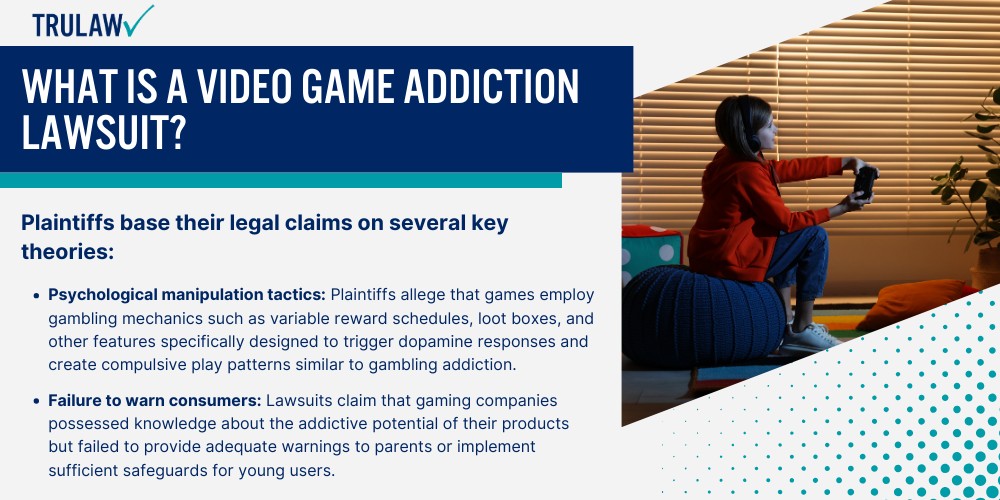
Plaintiffs base their legal claims on several key theories:

  • Psychological manipulation tactics: Plaintiffs allege that games employ gambling mechanics such as variable reward schedules, loot boxes, and other features specifically designed to trigger dopamine responses and create compulsive play patterns similar to gambling addiction.
  • Failure to warn consumers: Lawsuits claim that gaming companies possessed knowledge about the addictive potential of their products but failed to provide adequate warnings to parents or implement sufficient safeguards for young users.
  • Seeking accountability for documented harm: Cases pursue compensation for mental health disorders, academic decline, social isolation, and physical health consequences resulting from excessive gaming behavior.

The fact that the medical community now recognizes video game addiction strengthens these legal claims considerably.

The World Health Organization included gaming disorder in ICD-11, which became effective January 1, 2022, classifying it as an addictive behavior disorder characterized by impaired control over gaming, increasing priority given to gaming over other activities, and continuation despite negative consequences.

According to the American Psychiatric Association’s research on internet gaming, approximately 0.3 to 1.0 percent of the general population might qualify for a potential diagnosis of internet gaming disorder.

Among adolescents, prevalence estimates reach as high as 8.6% globally, with the highest rates observed in China at 11.7%.

This formal recognition by major health organizations provides plaintiffs with established diagnostic criteria to support their claims of addiction-related harm and creates a medical foundation for demonstrating that video game addiction is a legitimate condition with documented consequences.

If you or a loved one has experienced mental health problems, academic decline, or other harm related to excessive video game use, you may be eligible to seek compensation.

Contact TruLaw using the chat on this page to receive an instant case evaluation that can help you determine if you qualify to join others in filing a video game addiction lawsuit today.
Major Gaming Companies Facing Legal Action

The video game addiction litigation targets some of the largest and most influential companies in the global gaming industry.

Defendants named in current lawsuits include major video game companies such as Microsoft, Activision Blizzard, Epic Games, Roblox Corporation, Nintendo, Electronic Arts, and several others whose products reach hundreds of millions of users worldwide.

These companies face allegations that they deliberately designed games with features intended to optimize engagement and spending, particularly among young and vulnerable players.

The FTC’s enforcement action against Epic Games, which resulted in a $245 million settlement and mandated an overhaul of the company’s billing practices while barring the use of dark patterns, demonstrates the regulatory scrutiny these companies now face alongside private litigation.

Microsoft and Activision Blizzard

Microsoft and Activision Blizzard stand among the most prominent defendants in video game addiction litigation.

Microsoft faces allegations related to its Xbox console, Xbox Game Pass subscription service, and exclusive titles including Minecraft, Halo, and Gears of War.

Following Microsoft’s acquisition of Activision Blizzard, the combined entity now faces claims spanning multiple gaming platforms and franchises.

The lawsuits target multiple franchises under the Microsoft and Activision Blizzard umbrella:

  • Call of Duty franchise: Plaintiffs claim the popular shooter series employs engagement-maximizing mechanics, including battle passes, seasonal content, and reward systems designed to encourage compulsive play.
  • World of Warcraft: The long-running MMORPG faces allegations of using variable reward schedules and social pressure mechanics that create addiction among players.
  • Overwatch: Claims target the game’s loot box system and competitive ranking features as mechanisms designed to trigger compulsive behavior.
  • Minecraft: Despite its creative focus, allegations cite the game’s open-ended nature and in-game marketplace as contributing to excessive play among children.

In September 2024, Activision Blizzard, Roblox, Microsoft, Nintendo, and other major defendants filed motions to dismiss the lawsuits, arguing that their games are protected expression and that plaintiffs failed to establish causation.

These motions remain pending as litigation continues through pretrial proceedings.

Epic Games and Roblox Corporation

Epic Games and Roblox Corporation represent primary targets in video game addiction litigation due to the popularity of their platforms among young users.

Both companies face allegations of specifically designing features that exploit psychological vulnerabilities in children and adolescents to optimize engagement and monetization.

Both companies face substantial allegations alongside documented regulatory enforcement:

  • Epic Games FTC settlement: In December 2022, Epic Games agreed to pay $245 million to settle FTC allegations of deceptive billing practices in Fortnite, with the agency citing the company’s use of dark patterns to charge consumers without consent.
  • Consumer refund distribution: In December 2024, the FTC distributed over $72 million in refunds to Fortnite consumers, representing 629,344 payments averaging $114 each, with additional refund rounds expected.
  • Roblox targeting allegations: Plaintiffs claim Roblox Corporation specifically targets neurodivergent individuals and minors through game design that exploits developmental vulnerabilities.
  • Compulsive play mechanics: Both platforms face claims that time-limited events, artificial scarcity, and in game rewards are deliberately designed to trigger compulsive play patterns.

Fortnite, one of the most popular games, has over 650 million registered users, with 110 million monthly active players and 30 million daily active players.

Approximately 46% of U.S. teenagers play Fortnite on smartphones, with 69% playing on console, demonstrating the extensive reach of these platforms among young gamers.

Nintendo, Electronic Arts, and Other Defendants

Beyond the primary defendants, video game addiction litigation extends to numerous other companies across the video game industry whose products allegedly incorporate addictive design features.

These defendants collectively represent a broad cross-section of the gaming industry, from console manufacturers to mobile game publishers.

The litigation extends to numerous other gaming industry defendants:

  • Nintendo: Faces allegations related to loot box mechanics in mobile games, particularly Mario Kart Tour, which plaintiffs claim uses gacha-style monetization designed to encourage repeated purchases.
  • Electronic Arts (EA): Named for microtransaction systems in FIFA Ultimate Team, Madden, and Apex Legends, with claims that these features constitute gambling-like mechanics targeting young players.
  • Other defendants: Sony Interactive Entertainment (PlayStation Network), Rockstar Games (Grand Theft Auto), 2K Games, and Valve Corporation (Counter-Strike) are also named in various complaints.

Under product liability legal frameworks, video game manufacturers face potential liability for design defects, manufacturing defects, and failure to warn consumers about the risks associated with their products.

The industry-wide scope of litigation reflects growing legal scrutiny of monetization practices across the gaming sector.

If you or your child has developed a gaming addiction after playing Fortnite, Roblox, Minecraft, or other video games, you may qualify to pursue legal action.

Contact TruLaw using the chat on this page to receive an instant case evaluation that can help you determine if you qualify to file a video game addiction lawsuit today.
Legal Grounds and Allegations in Video Game Lawsuits

Video game addiction lawsuits rest on several legal theories that form the foundation for holding gaming companies accountable.

Plaintiffs argue that these companies violated consumer protection laws through deceptive design practices and failed in their duty to warn users about the addictive nature of their products.

The failure to warn doctrine provides a framework for these claims, as it does not require proof of physical product flaws but instead alleges that manufacturers failed to provide adequate warnings or instructions about safe product use.

This legal theory, combined with allegations of deceptive practices and privacy violations, forms the basis for the damages sought in current litigation.

Product Liability and Failure to Warn

Product liability theories traditionally applied to physical products are now being extended to video games in addiction litigation.

Plaintiffs argue that games designed with inherently addictive features constitute defective products when manufacturers fail to adequately warn consumers about the risks of excessive use.

Plaintiffs assert several product liability claims against gaming companies:

  • Design defects: Claims that games were intentionally designed with addictive mechanics without adequate consumer warnings, making the products unreasonably dangerous for their intended use.
  • Inadequate parental warnings: Allegations that parents were not properly informed about the potential dangers of excessive gaming, depriving them of the opportunity to make informed decisions about their children’s game use.
  • Comparison to pharmaceutical liability: Plaintiffs draw parallels to cases where drug manufacturers must disclose known risks, arguing gaming companies should face similar disclosure obligations.
  • Profit over safety: Claims that companies prioritized revenue and engagement metrics over user safety, despite internal knowledge of addiction risks.

Under product liability legal standards, there are generally three types of claims: manufacturing defects, design defects, and failure to warn (also known as marketing defects).

Manufacturers have an ongoing duty to monitor their products and warn consumers of newly discovered risks.

Unlike prescription medications where the learned intermediary doctrine places warning duties on physicians, no similar intermediary exists for video games, placing the duty to warn directly on gaming companies.

Deceptive Practices and “Dark Patterns”

Dark patterns represent a category of deceptive design techniques that manipulate user behavior through interface tricks and psychological exploitation.

The FTC has formally recognized these as problematic gaming practices, and their use in video games forms a central allegation in addiction litigation.

Lawsuits identify specific dark pattern techniques employed by gaming companies:

  • Loot boxes and variable rewards: Random reward systems that exploit psychological vulnerabilities by providing intermittent reinforcement, similar to slot machine mechanics.
  • Time-limited offers and artificial scarcity: Features that create urgency and fear of missing out, pressuring players to make immediate purchases of in game items or extend play sessions.
  • Misleading probability representations: Allegations that games fail to accurately disclose the odds of obtaining valuable items from randomized systems.
  • Grinding mechanics: The FTC specifically identified grinding as a dark pattern in 2022, defining it as making free game versions so cumbersome that players are induced to make in-app purchases.

The FTC’s 2022 report on dark patterns found these deceptive design practices used across multiple industries, including video games, with tactics including disguised advertisements, hidden fees, and manipulative interfaces designed to trick consumers.

Additional dark patterns cited in litigation include counterintuitive button configurations that cause unwanted purchases, hidden cancel and refund features, premium currencies that obscure actual costs, and auto-renewing subscriptions that are difficult to cancel.

Internal testing at Epic Games reportedly showed that designers intentionally obscured refund features, contributing to the FTC’s enforcement action and subsequent settlement.

Privacy Violations and Data Harvesting

Privacy law violations represent another category of allegations in video game addiction lawsuits, with plaintiffs claiming that gaming companies illegally collected personal data from minors to exploit psychological triggers and target vulnerable users with manipulative content.

Privacy law violations form another category of claims in these lawsuits:

  • COPPA violations: Claims that gaming companies collected personal information from children under 13 without obtaining verifiable parental consent as required by the Children’s Online Privacy Protection Act.
  • CCPA violations: Allegations of California Consumer Privacy Act violations related to data collection and use practices.
  • Targeting vulnerable users: Claims that collected data was used to identify and target vulnerable users with personalized content designed to deepen engagement and addiction.

Epic Games paid a record $275 million COPPA penalty in 2022 (the largest ever for an FTC rule violation) for collecting children’s personal information without parental notice or consent.

The FTC alleged that Epic knew children comprised a substantial portion of Fortnite’s audience, with 53% of children ages 10-12 playing the game weekly.

TruLaw partners with video game addiction litigation leaders to provide clients with the legal resources and support needed to pursue these claims effectively.

Internet Gaming Disorder: A Recognized Mental Health Condition

Internet Gaming Disorder (IGD) has been formally recognized by major health organizations as a legitimate medical condition, providing a strong foundation for legal claims in video game addiction lawsuits.

This recognition establishes that video game addiction is not merely a behavioral choice but a diagnosable condition with documented diagnostic criteria and measurable impacts on daily functioning and overall well-being.

The American Psychiatric Association notes that the World Health Organization has included gaming disorder in the 11th Revision of the International Classification of Diseases (ICD-11), marking a milestone in the medical community’s acknowledgment of gaming-related harm.

This formal classification strengthens plaintiffs’ ability to demonstrate that their injuries are medically recognized and causally connected to excessive gaming behavior.

WHO and DSM-5 Recognition

The formal medical recognition of gaming disorder by international health organizations provides plaintiffs with established diagnostic frameworks to support their legal claims.

This recognition represents years of clinical research into the addictive potential of video games and their documented effects on mental health, social relationships, and daily functioning.

Major health organizations have taken substantial steps to recognize gaming disorder:

  • WHO ICD-11 classification: The World Health Organization included gaming disorder in ICD-11 as an addictive behavior disorder, with the classification becoming effective January 1, 2022. The WHO defines gaming disorder as persistent or recurrent gaming behavior characterized by impaired control, increasing priority given to gaming over other activities, and continuation despite negative consequences.
  • DSM-5 inclusion: The American Psychiatric Association listed Internet Gaming Disorder in DSM-5 Section 3 as a condition warranting further study, establishing preliminary diagnostic criteria while calling for additional research.
  • Diagnostic duration requirements: Both frameworks require that symptoms persist for at least 12 months and result in functional impairment in personal, family, social, educational, or occupational areas before a diagnosis can be made.

Prevalence research supports the scope of this condition.

Studies estimate that 0.3% to 1.0% of the general population may qualify for an IGD diagnosis, with a global adjusted prevalence of approximately 3%.

Among adolescents, rates climb substantially higher, with estimates ranging from 4.6% to 8.6% globally.

Research consistently shows higher rates among males (8.5%) compared to females (3.5%), and adolescents in China show the highest prevalence at approximately 11.7%.

These statistics demonstrate that gaming addiction affects millions of individuals worldwide, supporting the premise that gaming companies’ products cause widespread harm.

The Nine DSM-5 Diagnostic Criteria

The DSM-5 established specific diagnostic criteria for Internet Gaming Disorder, requiring that individuals meet five or more of nine criteria to receive a diagnosis.

Research has validated these criteria and identified which symptoms most strongly predict a gaming addiction diagnosis.

The DSM-5 outlines nine diagnostic criteria for Internet Gaming Disorder:

  • Preoccupation: Persistent thoughts about gaming when not actively playing, including anticipation of the next gaming session.
  • Withdrawal symptoms: Experiencing irritability, anxiety, or sadness when gaming is restricted or unavailable.
  • Tolerance: Needing to spend increasing amounts of time gaming to achieve the same level of satisfaction.
  • Loss of control: Unsuccessful attempts to control or reduce gaming behavior despite wanting to cut back.
  • Giving up other activities: Loss of interest in previously enjoyed hobbies, social activities, and relationships due to gaming.
  • Continuation despite problems: Continuing to game despite knowing it causes problems at school, work, or in relationships.
  • Deception: Lying to family members, therapists, or others about the amount of time spent gaming.
  • Escape: Using gaming to escape negative moods or relieve feelings of helplessness, guilt, or anxiety.
  • Jeopardized relationships or opportunities: Risking or losing relationships, jobs, or educational opportunities because of gaming.

Research published in peer-reviewed journals has examined which criteria best correspond to an IGD diagnosis.

While “preoccupation” is the most commonly endorsed criterion (reported by 15.63% of study participants), research shows that “giving up other activities,” “continuation despite negative consequences,” and “jeopardizing relationships” are the strongest diagnostic predictors, with Cohen’s kappa values exceeding 0.45.

One study of Chinese adolescents found an overall IGD prevalence of 4.63%, with rates of 7.85% among males and 2.07% among females, demonstrating the condition’s particular impact on young male players.

TruLaw helps families determine whether their child’s gaming behavior meets the criteria for legal action through a free instant case evaluation.

Signs and Symptoms of Video Game Addiction

Recognizing the signs and symptoms of video game addiction is the first step toward seeking help and potentially pursuing legal action against gaming companies.

Parents and family members play a vital role in identifying problematic online gaming patterns that distinguish addiction from healthy recreational play, and early intervention can prevent long-term harm.

According to the Cleveland Clinic, an estimated 1.7% to 10% of the U.S. population is addicted to video games.

The wide range reflects varying diagnostic criteria and study methodologies, but even conservative estimates suggest millions of Americans struggle with compulsive gaming behavior that interferes with their daily lives, relationships, educational progress, and professional responsibilities.

Behavioral Warning Signs

Behavioral indicators of video game addiction often manifest before physical symptoms become apparent.

These warning signs reflect the psychological grip that games can have on players, particularly children and adolescents whose brains are still developing impulse control and decision-making capabilities.

Parents should watch for these behavioral indicators of gaming addiction:

  • Preoccupation with gaming: Constantly thinking about gaming when not playing, including planning the next session, strategizing about in-game activities, or watching gaming-related content online.
  • Withdrawal symptoms: Experiencing sadness, anxiety, irritability, or anger when gaming is restricted or when unable to play due to other obligations.
  • Failed attempts to control gaming: Making repeated unsuccessful attempts to reduce gaming time despite recognizing that gaming is causing problems in other areas of life.
  • Loss of interest in other activities: Abandoning previously enjoyed hobbies, sports, creative pursuits, and social activities in favor of gaming.
  • Continuation despite negative consequences: Continuing to play video games even while knowing it causes problems at school, work, or home, or damages relationships with family and friends.

The Cleveland Clinic identifies additional behavioral indicators that parents should monitor, including using gaming to escape problems or relieve negative emotions, lying to family members about time spent gaming, and needing to spend increasing amounts of time playing to achieve the same level of satisfaction.

These tolerance and deception patterns mirror those seen in other recognized addictive disorders.

Risk factors that may increase vulnerability to developing gaming disorder include impulsivity, low self-control, social anxiety, and low self-esteem.

Parents who observe multiple behavioral warning signs persisting over several months should consider seeking professional evaluation and exploring legal options against gaming companies whose products may have contributed to the addiction.

Physical and Social Indicators

Beyond behavioral changes, video game addiction manifests through physical symptoms and social deterioration that can have lasting effects on a young person’s development and quality of life.

These indicators often provide objective, documentable evidence of harm that can support legal claims against gaming companies in addiction litigation.

Gaming addiction also manifests through physical symptoms and social deterioration:

  • Decline in personal hygiene: Neglecting basic self-care activities such as bathing, grooming, and changing clothes due to prioritizing gaming over personal maintenance.
  • Sleep disruption: Staying up late or through the night to play games, resulting in chronic sleep deprivation, difficulty waking for school or work, and disrupted circadian rhythms.
  • Physical health deterioration: Developing repetitive stress injuries in hands and wrists, experiencing frequent headaches, eye strain, and weight changes from sedentary behavior.
  • Social withdrawal: Isolating from family and friends, declining invitations to social activities, and preferring online interactions over in-person relationships.
  • Academic and occupational decline: Falling grades, incomplete assignments, poor attendance, and deteriorating work performance as gaming consumes time previously devoted to responsibilities.

Research published in JAMA Network Open found that for every additional hour of daily screen time during early childhood, children had 9 to 10 percent lower odds of scoring at a higher academic level in Grade 3 reading and math assessments.

The study tracked over 3,000 Ontario children from 2008 to 2023 and found that video game playing was specifically associated with lower composite academic scores, with an effect size of -0.15.

Notably, watching television and playing video games were the only screen activities negatively associated with academic performance.

High levels of screen time may displace academic-promoting activities such as physical activity, peer play time, and adequate sleep, creating a cascade of developmental consequences that can persist throughout a child’s educational journey.

These documented harms provide evidence that families can use when pursuing legal claims against gaming companies.

TruLaw gives immediate answers to individuals about their eligibility for video game addiction litigation based on the details they share through our chat evaluation tool.

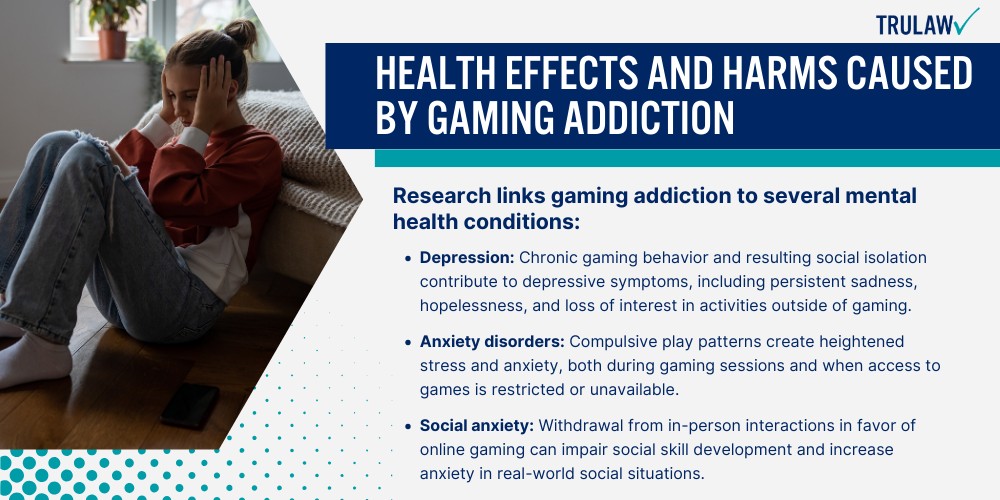
Health Effects and Harms Caused by Gaming Addiction

Video game addiction causes documented physical, mental, and emotional harms that form the basis for damages sought in litigation against gaming companies.

These injuries range from psychological conditions like depression and anxiety to physical health consequences resulting from prolonged sedentary behavior and disrupted sleep patterns.

The Cleveland Clinic notes that excessive gaming can lead to aggressive behavior, disrupted sleep patterns, unhealthy escapism, depression, and social anxiety.

These documented health effects provide plaintiffs with evidence of the harm caused by gaming companies’ allegedly addictive products and support claims for compensation covering medical treatment, therapy, and other related damages.

Mental Health Consequences

Gaming addiction has been linked to a range of mental health conditions that can persist long after gaming behavior is brought under control.

The psychological toll of compulsive gaming affects emotional regulation, social development, and overall mental well-being, particularly in young people whose brains are still developing.

The U.S. Surgeon General’s Advisory on Social Media and Youth Mental Health warns that we cannot conclude digital platforms are sufficiently safe for children and adolescents, calling for immediate action to protect young people from potential harms to their mental health.

Research links gaming addiction to several mental health conditions:

  • Depression: Chronic gaming behavior and resulting social isolation contribute to depressive symptoms, including persistent sadness, hopelessness, and loss of interest in activities outside of gaming.
  • Anxiety disorders: Compulsive play patterns create heightened stress and anxiety, both during gaming sessions and when access to games is restricted or unavailable.
  • Social anxiety: Withdrawal from in-person interactions in favor of online gaming can impair social skill development and increase anxiety in real-world social situations.
  • Emotional dysregulation: Difficulty managing emotions, including increased irritability, anger outbursts, and mood swings related to gaming access and performance.

A McGill University study published in JAMA Psychiatry in April 2024 followed 1,226 participants to examine the relationship between adolescent media use and adult mental health outcomes.

The researchers found that approximately 12% of participants reported frequent gaming between ages 12 and 17.

While the study found that associations between adolescent media use and later psychotic experiences were largely explained by pre-existing mental health difficulties, it also revealed that youth drawn to heavy gaming often had higher levels of mental health challenges before adolescence, suggesting a pattern where vulnerable individuals may be particularly susceptible to gaming-related harm.

The National Institute of Mental Health provides resources on child and adolescent mental health, noting that for many adults with mental disorders, symptoms were present but often not recognized or addressed in childhood and adolescence, making early treatment a priority.

Physical Health Impacts

Excessive gaming takes a measurable toll on physical health, with consequences ranging from acute injuries to chronic conditions associated with sedentary lifestyles.

These physical health impacts provide objective, documentable evidence of harm in video game addiction litigation.

Excessive gaming produces measurable physical health effects:

  • Repetitive stress injuries: Prolonged gaming sessions cause physical injuries to hands, wrists, and arms, including carpal tunnel syndrome, tendinitis, and other musculoskeletal conditions requiring medical treatment.
  • Sleep disorders: Gaming disrupts circadian rhythms, leading to chronic sleep deprivation, insomnia, and associated health problems including impaired immune function and cognitive deficits.
  • Obesity and metabolic issues: Sedentary gaming behavior contributes to weight gain, reduced physical fitness, and increased risk of obesity-related health conditions.
  • Seizure risk: Certain visual stimuli in games, including flashing lights and rapid screen changes, can trigger photosensitive seizures in vulnerable individuals.

According to the Mayo Clinic Health System, screen time can be highly engaging for people of all ages, but when violent video games depict dangerous situations, the gamer’s body reacts accordingly with stress responses.

This hyperarousal leads to difficulties with attention, emotional regulation, and impulse control.

Additional physical consequences include frequent headaches, migraines, and computer vision syndrome from extended screen exposure, all of which may require ongoing medical attention and contribute to damages in legal claims.

Developmental and Academic Harms

Children and adolescents face particular risks from gaming addiction due to the impact on neurological, behavioral, and social development during formative years.

These developmental harms can have lasting consequences that extend well beyond childhood.

A National Institutes of Health study on excessive screen time found that early screen exposure has been associated with lower cognitive abilities and academic performance in later years, with language development also affected as screen time diminishes the quantity and quality of interactions between children and caregivers.

Children and adolescents face particular developmental and academic risks:

  • Academic decline: The JAMA Network Open study found that each additional hour of video game play correlates with lower reading and math achievement scores, with effects observed in Grade 3 and Grade 6 assessments.
  • Disrupted development: High levels of screen time during preschool and early elementary years may displace activities that promote healthy neurological, behavioral, and social development.
  • Need for intervention: Many affected children require specialized educational plans, tutoring, therapy, and other interventions to address gaming-related developmental delays.

Data from the CDC’s National Center for Health Statistics found that 50.4% of teenagers ages 12-17 reported four or more hours of daily screen time, with teenagers who had higher daily screen time more likely to experience mental health struggles including anxiety and depression symptoms.

TruLaw partners with video game addiction litigation leaders to help families seek compensation for these documented harms.

Who Qualifies to File a Video Game Addiction Lawsuit?

Eligibility for video game addiction lawsuits depends on several factors that attorneys evaluate when determining whether an individual or family has a viable legal claim.

These criteria focus on the age at which gaming began, the specific games involved, and the documented harm resulting from excessive play.

This diagnostic pathway provides the medical documentation that strengthens legal claims and helps establish the causal connection between gaming and documented injuries.

Age and Exposure Requirements

Age-related eligibility criteria reflect the particular vulnerability of developing brains to addictive gaming mechanics.

Current litigation primarily focuses on individuals who began gaming during childhood or adolescence, when the brain’s reward systems and impulse control mechanisms are still maturing.

The NIMH-NICHD Workshop on Impact of Technology and Digital Media brought together experts to examine the effects of technology on child and adolescent development and mental health, reflecting federal research priorities in this area.

Current litigation focuses on plaintiffs who meet specific age and exposure requirements:

  • Age at addiction onset: Generally, individuals 22 years or younger who developed gaming addiction may qualify for legal action, with particular focus on those whose addiction began during childhood.
  • Developing brain vulnerability: Gaming behavior typically must have begun before age 25 due to the increased vulnerability of developing brains to addictive mechanisms and reward-based design features.
  • Exposure to specific games: Eligibility often requires exposure to games with documented addictive features, including loot boxes, microtransactions, variable reward systems, and engagement-maximizing mechanics.

The California coordinated cases involve minors and young adults who became addicted to Roblox, Fortnite, or Minecraft as children and subsequently required professional intervention to address their compulsive gaming behavior.

One case in the coordinated proceeding involves an 8-year-old plaintiff who began gaming at age 3 and now plays 5 to 9 hours daily, demonstrating how early exposure can lead to severe addiction patterns that persist throughout childhood.

Plaintiffs must demonstrate that gaming began during formative years when brain development was ongoing and that they were exposed to games specifically designed to create compulsive play behaviors through reward mechanisms and engagement features.

The focus on young players reflects research showing that 62.7% of Fortnite players are between 18 and 24 years old, representing individuals who likely began playing digital games during adolescence when their brains were particularly vulnerable to addictive design elements.

Documented Harm and Medical Diagnosis

Strong legal claims require documentation of harm resulting from gaming addiction.

This evidence demonstrates both the existence of addiction and the specific injuries caused by compulsive gaming behavior, establishing the foundation for damages sought in litigation.

Strong legal claims rely on comprehensive documentation of harm:

  • Formal diagnosis: A diagnosis of Internet Gaming Disorder or documented treatment for gaming addiction from qualified healthcare providers, including psychiatrists, psychologists, or addiction specialists.
  • Mental health records: Evidence of mental health conditions linked to gaming, including depression, anxiety, eating disorders, social withdrawal, and emotional dysregulation documented in medical or therapy records.
  • Educational documentation: School records showing academic decline, behavioral reports, 504 plans, individualized education plans (IEPs), or records of tutoring and educational interventions necessitated by gaming-related difficulties.
  • Financial records: Documentation of unauthorized in-game purchases, credit card charges for gaming content, and other financial losses attributable to gaming addiction.

According to the Cleveland Clinic’s diagnostic guidelines, gaming behavior patterns must typically exist for at least one year and be extreme enough to result in impairment to personal, family, social, educational, or occupational functioning before a formal diagnosis can be made.

The strongest cases involve plaintiffs who can demonstrate a clear timeline of gaming exposure, the onset of addiction symptoms, documented treatment efforts, and measurable harm in multiple life areas.

Evidence of physical symptoms such as repetitive stress injuries and sleep disorders further strengthens claims, as do records showing behavioral changes observed and documented by family members, teachers, therapists, and healthcare providers over time.

If your child has been diagnosed with Internet Gaming Disorder or has required treatment for gaming addiction, you may be eligible to seek compensation from gaming companies.

Contact TruLaw using the chat on this page to receive an instant case evaluation that can help you determine if you qualify to file a video game addiction lawsuit today.
How to File a Video Game Addiction Lawsuit

Filing a video game addiction lawsuit involves a structured process that begins with an initial case evaluation and proceeds through documentation gathering, attorney review, and formal litigation.

Families considering legal action should understand the steps involved from initial consultation through potential case resolution.

The documentation gathering process requires collecting medical records, therapy notes, treatment records, school reports showing declining performance, and financial records of unauthorized game purchases.

This evidence forms the foundation of legal claims and helps attorneys assess the strength of potential cases against gaming companies.

Initial Case Evaluation and Documentation

The first step in pursuing a video game addiction lawsuit is obtaining a free case evaluation from an experienced attorney who can assess eligibility and the potential strength of a legal claim.

This evaluation helps families understand whether their circumstances meet the criteria for litigation and what evidence will be needed to support their case.

The evaluation and documentation process follows several key steps:

  • Free case evaluation: Contact a law firm experienced in video game addiction litigation to receive an assessment of your potential claim based on the specific details of your situation, including the games involved and documented harm.
  • Medical record collection: Gather all medical records documenting diagnosis and treatment for gaming addiction, including psychiatrist evaluations, therapy notes, and records of any medications prescribed for related mental health conditions.
  • School documentation: Collect school records showing academic decline, behavioral incident reports, 504 plans, individualized education plans (IEPs), attendance records, and any tutoring or intervention services provided.
  • Financial evidence: Compile records of in-game purchases, unauthorized credit card transactions, bank statements showing gaming-related spending, and evidence of financial losses attributable to gaming addiction.

Building a strong evidentiary foundation requires documenting the timeline of gaming exposure and symptom development comprehensively.

Evidence gathering recommendations emphasize seeking help from healthcare providers who specialize in gaming disorder if professional treatment has not already been obtained.

Screenshots of gaming history, time-played statistics, and records of specific games accessed through digital app stores help establish the connection between particular products and the resulting addiction.

Testimony from family members about observed behavioral changes, combined with professional assessments and school records, creates a comprehensive picture of how gaming addiction developed and the specific harms it caused over time.

The Litigation Process

Once an attorney has reviewed documentation and determined that a viable claim exists, the formal litigation process begins.

This process involves filing a lawsuit against the appropriate defendants and proceeding through pretrial stages that may include discovery, motions, and potential settlement negotiations.

Once attorneys determine a viable claim exists, litigation proceeds through distinct stages:

  • Attorney review and case filing: After evaluating the evidence, attorneys file a lawsuit against appropriate defendants, which may include game developers, publishers, and platform operators whose products contributed to the addiction.
  • Discovery process: The discovery phase allows plaintiffs to obtain internal company documents about game design decisions, marketing strategies targeting young users, and any evidence of company knowledge about addictive features.
  • Case management and coordination: Cases may be coordinated with other similar lawsuits for efficient pretrial proceedings, as with the California JCCP No. 5363 coordinated proceeding.
  • Resolution options: Cases may resolve through settlement negotiations, arbitration (if required by user agreements), or proceed to trial for a jury verdict.

The California coordinated proceeding in Los Angeles Superior Court consolidates over 100 lawsuits before a single judge, streamlining pretrial proceedings and managing overlapping legal and factual issues efficiently across multiple plaintiffs.

Individual lawsuits rather than class actions currently predominate in video game addiction litigation, allowing each family’s unique circumstances to be evaluated on their own merits rather than being grouped together.

Some cases have been directed to arbitration based on terms in user agreements, as occurred with the Angelilli, Dunn, and Johnson cases.

No trial dates have been set as of June 2025, with pretrial proceedings including discovery and case management conferences ongoing.

The discovery process provides plaintiffs with access to internal company documents that may reveal what gaming companies knew about creating games with addictive features, when they knew it, and what steps they took or failed to take to protect users.

TruLaw partners with video game addiction litigation leaders to provide clients with the legal resources and support necessary for a successful outcome.

Video Game Lawsuit Settlement Amounts and Case Outcomes

Families considering video game addiction lawsuits often want to know what compensation they might receive and how similar cases have resolved.

While individual settlements in video game addiction litigation remain pending, regulatory actions and enforcement outcomes provide context for potential case values.

The FTC’s $245 million settlement with Epic Games for deceptive billing practices represents the largest consumer refund in gaming case history and demonstrates the scale of potential accountability.

As this litigation develops, settlement amounts will depend on individual circumstances including the severity of addiction, documented harm, and the strength of evidence connecting specific games to injuries.

Estimated Settlement Ranges

Video game addiction litigation remains in its early stages, with no major individual settlements finalized as cases continue through pretrial proceedings.

However, legal experts have provided estimates based on the severity of documented harm and factors that typically influence case valuations in product liability litigation.

Several factors influence potential compensation amounts in these cases:

  • Severity of addiction: The duration and intensity of gaming addiction, including daily hours spent gaming and the length of time addiction persisted before intervention.
  • Documented medical and psychological harm: Evidence of diagnosed conditions including Internet Gaming Disorder, depression, anxiety, and other mental health disorders requiring professional treatment.
  • Educational and developmental impact: Documentation of academic decline, need for specialized educational plans, tutoring, and other interventions to address gaming-related educational deficits.
  • Financial losses: Unauthorized in-game purchases, costs of treatment and therapy, and other direct financial harm attributable to gaming addiction.
  • Age-related vulnerabilities: Cases involving younger children who began gaming during early developmental stages may receive higher valuations due to the increased vulnerability of developing brains.

According to settlement amount analysis from legal experts, no individual settlements have been finalized in video game addiction litigation as of 2025, with cases remaining in pretrial and discovery phases.

Legal experts estimate that high-value cases involving severe documented harm could potentially exceed $250,000, though actual amounts will depend on the specific facts of each case.

The strength of causation evidence linking specific games to documented harm will play a substantial role in determining compensation, as will evidence demonstrating that gaming companies knew about the addictive nature of their products and failed to implement adequate safeguards.

FTC Actions and Regulatory Outcomes

Federal Trade Commission enforcement actions against gaming companies provide precedent for accountability and demonstrate regulatory recognition of harmful industry practices.

These actions, while not individual lawsuit settlements, signal increased scrutiny of gaming industry conduct and establish benchmarks for potential damages.

The FTC has taken substantial enforcement action against gaming companies:

  • Epic Games total penalties: Epic Games paid $520 million total to resolve FTC allegations, comprising a $275 million COPPA penalty (the largest ever for an FTC rule violation) plus $245 million designated for consumer refunds.
  • Consumer refund distribution: In December 2024, the FTC distributed more than $72 million in refunds to consumers who were harmed by Epic Games’ billing practices, with 629,344 payments averaging $114 each sent via PayPal and checks.
  • Future refund rounds: Additional refund distributions are expected in 2026 as the FTC continues processing claims from affected Fortnite consumers.
  • Required business practice changes: The FTC settlement requires Epic to obtain affirmative consent before processing charges, prohibits the use of dark patterns, and bars the company from locking accounts when consumers dispute charges.

The FTC’s enforcement actions signal regulatory precedent for holding gaming companies accountable for practices that harm consumers, particularly children.

The record-setting COPPA penalty acknowledged that Epic knew children comprised a substantial portion of Fortnite’s audience, with 53% of children ages 10-12 playing the game weekly, yet failed to obtain proper parental consent for data collection.

This regulatory recognition of gaming industry misconduct strengthens the foundation for private litigation and demonstrates that federal agencies view certain gaming company practices as harmful and unlawful.

As individual lawsuits progress through the courts, these regulatory outcomes may influence settlement negotiations and jury deliberations.

Please be advised that any projected or estimated settlement amounts mentioned on this page are general estimations and are not guaranteed.

These figures are based on opinions of legal experts based on the nature of the injuries and estimated costs of damages.

They are meant to provide a general idea of what settlement ranges could look like and should not be taken as definitive expectations for your case.

Contact TruLaw using the chat on this page to receive an instant case evaluation.

How Can A Video Game Addiction Attorney from TruLaw Help You?

Our Video Game Addiction attorney at TruLaw is dedicated to supporting clients through the process of filing a Video Game Addiction lawsuit.

With extensive experience in product liability cases, Jessica Paluch-Hoerman and our partner law firms work with litigation leaders and mental health professionals to prove how video games with deliberately addictive features caused you harm.

TruLaw focuses on securing compensation for mental health treatment expenses, academic and career setbacks, family relationship damages, and other losses resulting from your video game addiction injuries.

We understand the psychological and social toll that Video Game Addiction issues have on your life and provide the personalized guidance you need when seeking justice.

Meet the Lead Video Game Addiction Attorney at TruLaw

Meet our lead Video Game Addiction attorney:

  • Jessica Paluch-Hoerman: As founder and managing attorney of TruLaw, Jessica brings her experience in product liability and personal injury to her client-centered approach by prioritizing open communication and personalized attention with her clients. Through TruLaw and partner law firms, Jessica has helped collect over $3 billion on behalf of injured individuals across all 50 states through verdicts and negotiated settlements.

How much does hiring a Video Game Addiction lawyer from TruLaw cost?

At TruLaw, we believe financial concerns should never stand in the way of justice.

That’s why we operate on a contingency fee basis – with this approach, you only pay legal fees after you’ve been awarded compensation for your injuries.

If you or a loved one experienced addiction, depression, sleep disorders, social isolation, or other mental health problems from excessive video game use, you may be eligible to seek compensation.

Contact TruLaw using the chat on this page to receive an instant case evaluation and determine whether you qualify to join others in filing a Video Game Addiction lawsuit today.

TruLaw: Accepting Clients for the Video Game Addiction Lawsuit

Video game addiction lawsuits are being filed by individuals and families across the country who suffered mental health injuries and addiction from video games designed with manipulative features.

TruLaw is currently accepting clients for the video game addiction lawsuit.

A few reasons to choose TruLaw for your video game addiction lawsuit include:

  • If We Don’t Win, You Don’t Pay: The video game addiction lawyers at TruLaw and our partner firms operate on a contingency fee basis, meaning we only get paid if you win.
  • Expertise: We have decades of experience handling consumer protection cases similar to the video game addiction lawsuit.
  • Successful Track Record: TruLaw and our partner law firms have helped our clients recover billions of dollars in compensation through verdicts and negotiated settlements.

If you or a loved one suffered from video game addiction or related mental health problems, you may be eligible to seek compensation.

Contact TruLaw using the chat on this page to receive an instant case evaluation that can determine if you qualify for the video game addiction lawsuit today.
Frequently Asked Questions

  • Individuals who developed gaming addiction, particularly minors who began playing video games as children, may qualify with documented harm evidence.

    Eligibility requires Internet Gaming Disorder diagnosis, mental health treatment records, academic decline, or other documented harms linked to certain video games like Fortnite, Roblox, or Minecraft.

    Parents can file on behalf of minor children, with cases strengthened by medical records, therapy documentation, school reports showing declining performance, and evidence of gaming-related behavioral changes observed over time by family members and professionals.

Published by:
Share
Picture of Jessica Paluch-Hoerman
Jessica Paluch-Hoerman

Attorney Jessica Paluch-Hoerman, founder of TruLaw, has over 28 years of experience as a personal injury and mass tort attorney, and previously worked as an international tax attorney at Deloitte. Jessie collaborates with attorneys nationwide — enabling her to share reliable, up-to-date legal information with our readers.

This article has been written and reviewed for legal accuracy and clarity by the team of writers and legal experts at TruLaw and is as accurate as possible. This content should not be taken as legal advice from an attorney. If you would like to learn more about our owner and experienced injury lawyer, Jessie Paluch, you can do so here.

TruLaw does everything possible to make sure the information in this article is up to date and accurate. If you need specific legal advice about your case, contact us by using the chat on the bottom of this page. This article should not be taken as advice from an attorney.

Additional Video Game Addiction Lawsuit resources on our website:
All
FAQs
Injuries & Conditions
Legal Help
Military
Other Resources
Settlements & Compensation
You can learn more about this topic by visiting any of our Video Game Addiction Lawsuit pages listed below:
2K Lawsuit for Video Game Addiction
Apex Legends Addiction Lawsuit
Call of Duty Addiction Lawsuit
Counter-Strike Video Game Addiction Lawsuit
EA Games Lawsuit for Video Game Addiction
Fortnite Addiction Lawsuit
Grand Theft Auto Addiction Lawsuit
League of Legends Lawsuit
Microsoft Lawsuit for Video Game Addiction
NBA 2K Lawsuit for Video Game Addiction
Nintendo Switch Addiction Lawsuit
Overwatch Lawsuit for Video Game Addiction
Rainbow Six Siege Addiction Lawsuit
Red Dead Redemption 2 Lawsuit for Video Game Addiction
Roblox Lawsuit for Video Game Addiction
Rocket League Addiction Lawsuit
Teamfight Tactics Lawsuit for Video Game Addiction
Video Game Addiction Lawsuit Payout & Settlement Amounts
Video Game Lawsuit
World of Warcraft Lawsuit | WoW Lawsuit for Addiction

Other Video Game Addiction Lawsuit Resources

All
FAQs
Injuries & Conditions
Legal Help
Military
Other Resources
Settlements & Compensation